Andrej Karpathy scored 342 US jobs on AI exposure. Product management scored near the top.
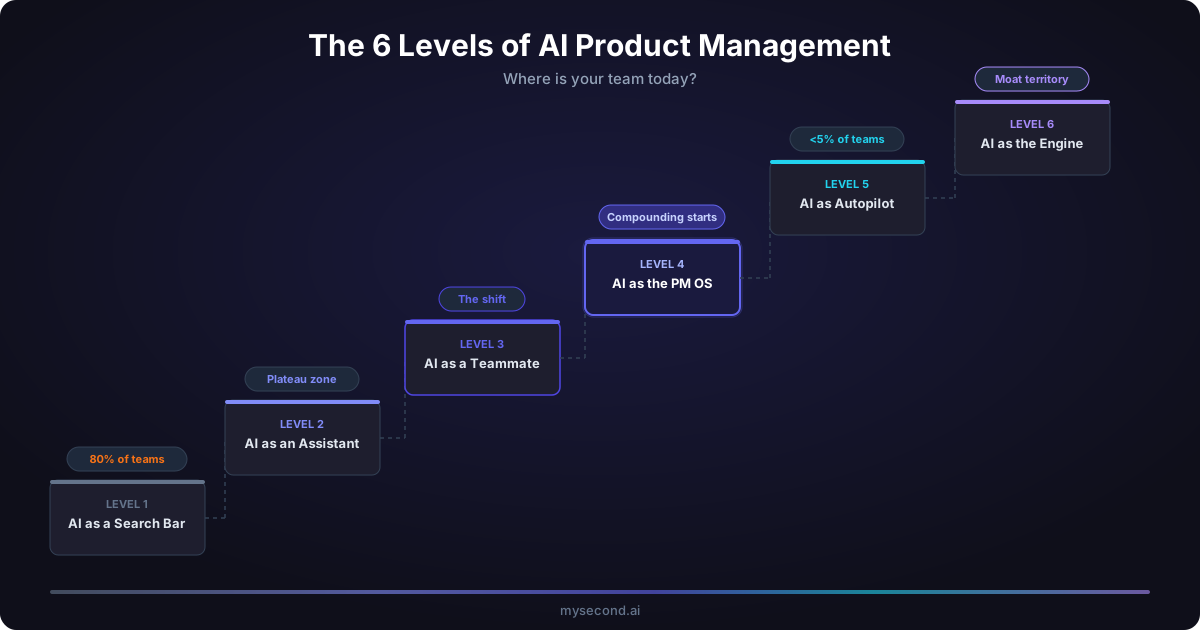
After spending a year building PM operating systems for product teams, I've identified 6 distinct levels of AI maturity in product management. Most teams are stuck at Level 1 or 2. The teams at Level 4+ are operating at a completely different speed.
Here's the full breakdown.
Level 1: AI as a Search Bar
This is where 80% of PM teams are today.
A PM needs to write a PRD. They open ChatGPT, type "help me write a PRD for a checkout redesign," get something generic, spend an hour giving Chat more information about the company and product. Finally, they paste it into a doc and move on.
Next week, different PM, same task. Starts from scratch.
What it looks like:
- Every PM uses AI differently (or not at all)
- No shared prompts, no shared context
- Output sounds like a blog post, not like someone who knows your product
- Every session starts from zero
- The "time saved" is an illusion — you're just moving text around
The AI doesn't know your product. It doesn't know your users. It doesn't know your competitors. It's a search bar with better grammar.
This is fine for exploring ideas. It's not a system.
Level 2: AI as an Assistant
Your team has shared prompt templates. Maybe a Notion doc with "how to use AI for competitive research." Maybe a few structured skills with detailed instructions.
This is real progress. PMs aren't starting from zero anymore.
What it looks like:
- Shared templates for PRDs, competitive briefs, research synthesis
- Consistent structure across the team
- But the AI still doesn't know your business
- Output needs heavy editing to reflect your product, market, customers
- The structure saves time — the lack of context costs it back
This is where most AI-forward PM teams plateau.
They think the problem is better prompts. It's not. The problem is the AI has no idea who you are.
Level 3: AI as a Teammate
This is the level that changes everything.
Someone on the team — usually your best PM — has loaded company context into their AI setup. Product details. Customer personas. Competitive landscape. Strategic priorities.
Now the AI doesn't just produce structure. It produces output that sounds like someone who works at your company.
What it looks like:
- First drafts are 80% usable, not 30%
- Competitive briefs reference your actual competitors, not generic ones
- PRDs reflect your product strategy, not a template
- Research synthesis connects to your existing customer segments
- One or two passes instead of five
Here's the problem: it's personal, not shared.
Your best PM's setup doesn't transfer to the next PM. If they leave, that knowledge walks out the door. The other PMs are still at Level 1 or 2.
This is where the Head of Product has a decision to make. Do you let every PM build their own system? Or do you build one system the entire team plugs into?
Level 4: AI as the PM Operating System
The whole team runs on the same system.
Same company context. Same skills. Same frameworks. Any PM runs the same task and gets consistent, business-aware output.
What it looks like:
- New PM joins Monday, produces usable output by Wednesday
- The swap test passes — PM Alice and PM Bob get comparable quality
- Competitive context stays current because someone owns it
- Research synthesis uses shared customer segments and strategic priorities
- Stakeholder updates pull from real product context, not guesswork
- Best practices (Teresa Torres, Marty Cagan) are embedded, not optional
This is where the compounding starts.
Every PM workflow that goes through the system makes the system smarter. Every research round updates the shared context. Every competitive shift gets reflected in every PM's output — automatically.
At Levels 1-3, AI helps individual PMs. At Level 4, AI runs the PM function.
That's a fundamentally different thing.
Level 5: AI as Autopilot
Workflows run without anyone triggering them.
Weekly competitive scans that show up in Slack Monday morning. Customer feedback synthesis that updates after every support cycle. Metric reports that flag anomalies before the PM even logs in.
What it looks like:
- Scheduled workflows across research, monitoring, and reporting
- The system feeds itself — outputs from one workflow become inputs for another
- PMs review and act on intelligence instead of producing it
- Agents handle the research-to-draft pipeline end to end
- One command triggers a full workflow: research, synthesize, draft, review
This is the subagent level.
Your PM system delegates tasks to specialized agents. A research agent pulls competitive data. An analyst agent structures the findings. A writer agent drafts the brief. A critic agent scores it before you ever see it.
One PM doing the work of a small team. The coordination cost drops to zero because there are no handoffs.
Fewer than 5% of PM teams are here today.
See this in your own workspace
Load your product context once. Every skill runs against it — calibrated to your product from the first run.
Start your free trialLevel 6: AI as the Engine
The difference between Level 5 and Level 6 is memory.
At Level 5, agents execute. At Level 6, agents learn.
The system tracks what works and what doesn't. It feeds performance data back into the next cycle. Context doesn't just stay current — it gets richer every week.
What it looks like:
- Run 1 produces a competitive brief and a first draft
- Run 5 adds win/loss patterns and sharper positioning based on what resonated
- Run 20 has audience feedback baked in, segment-specific messaging, and a track record of what converted
- The system compounds judgment over time
- Every cycle is better than the last because it builds on everything before it
This is where AI stops being a tool you use and becomes infrastructure you run.
Almost nobody is here yet. The teams building toward it now will have compounding advantages that late adopters can't catch up to.
Because the advantage isn't just speed. It's accumulated judgment, context, and months of memory that a competitor starting from scratch doesn't have.
The Gap Is Widening
The gap between Level 1 and Level 4 is widening every month.
A team at Level 4 onboards a new PM in days, not weeks. They run competitive analysis in hours, not days. They produce consistent output across the whole team.
A team at Level 1 is still copying and pasting into ChatGPT. Each PM reinventing the wheel. Output quality depending on who wrote the prompt.
And the gap compounds. Because a system at Level 4 gets better every week. A collection of individual prompts at Level 1 stays flat.
How to Move Up
Level 1 to 2: Pick one PM deliverable your team does weekly. Create a shared prompt template for it. Just one. See what happens.
Level 2 to 3: Write a one-page company context doc. Who you serve, how you win, top 3 competitors. Paste it into your AI tool's project instructions. The difference in output quality will be immediate.
Level 3 to 4: Stop letting every PM build their own setup. Create one shared context folder the whole team loads. Assign someone to own freshness.
Level 4 to 5: Identify one recurring workflow — competitive scans, metric summaries, research digests — and automate it end to end. Run it for 2 weeks. Compare to manual.
Level 5 to 6: Add memory. Start logging what performs and what doesn't. Feed that data back into your agents. Build a shared context layer that compounds over time.
Each jump takes days to weeks, not months. The hardest part isn't the work — it's deciding to do it.
The Real Moat
The moat in product management was always judgment. Knowing what to build. Knowing what to cut. Knowing when to say no.
AI doesn't replace that. But teams at Level 4+ have something the others don't: time to exercise judgment.
When your PMs aren't spending half their week producing artifacts, they spend it thinking. And thinking PMs build better products.
Inspired by Shann Holmberg's 5 Levels of AI Marketing.
Want to know where your team lands? Take the PM OS Assessment — 8 questions, 3 minutes, no email required.